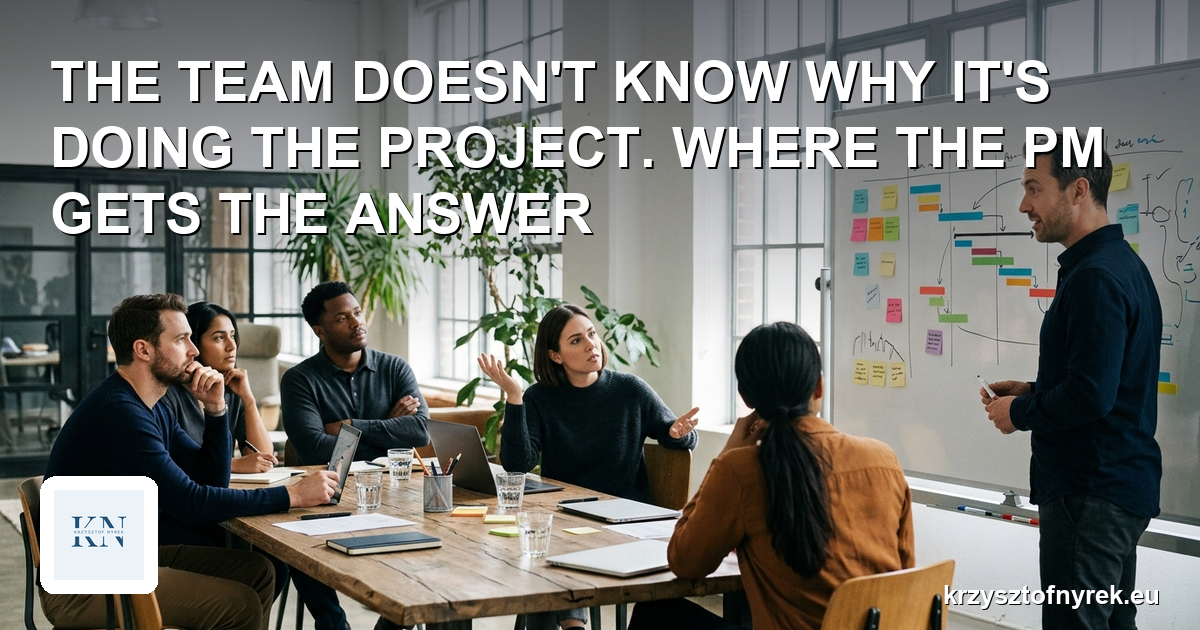

A kick-off for a new project. On the screen there is the schedule, the scope and the milestones, all prepared the way it should be. Near the end of the meeting someone from customer service speaks up, a person “borrowed” for the project two days a week: “Why are we actually doing this?”
There is a silence, and then someone answers that the board approved the project last quarter. That is true, but the person who asked goes back to their desk with the same question.
I’ll give you the most important point of this article straight away: a project manager can’t invent a purpose the sponsor never gave them. What they can do is get it out of the sponsor before the schedule starts running, and then translate it into something a team member will see in their own working week. Those are two separate jobs and both belong to the PM.
It happens most often with processes that already work but have to be changed for some reason. Perhaps new legal requirements have appeared, perhaps the project’s environment has changed, and then people ask a very simple question: why touch it if it works? One current example is implementing the requirement that a customer can withdraw from a contract in the same way the order was placed. In theory the process works, because the user can already cancel an order, for example by sending in a completed form, but the new requirements set by the EU are that cancelling should be easier for the user. The people on the project team don’t have to be up to date with this kind of information, so it is worth answering the question of why we are doing this at the meeting.
To start with, purpose gets discussed in projects less often than it seems
You might think the kick-off scene is an exception. Brown, Hyer and Ettenson, in “The Question Every Project Team Should Answer”, published in MIT Sloan Management Review, described project teams that had run into trouble, and noticed that many of them had never discussed why they were doing the project at all.
In my experience a team like that usually knows what it has to deliver and by when, while the question of which problem is supposed to disappear once the project is over stays unanswered.
Why does that happen? The sponsor usually knows the answer, only nobody has asked them for it in a way that could be repeated to the team. The business case says “optimisation of the order handling process”, and a person on the team has no idea what to do with that sentence on Monday morning.
The people who ask most often are the ones “borrowed” for the project
While we are here, it is worth looking at who asks about the purpose. It is rarely a developer or an analyst who has been in the project since the first conversation. More often it is someone from accounting, customer service or the warehouse, whom their manager has assigned for two days a week.
That person wasn’t in the meetings where the project took shape. Their own work is waiting in their home department. For them the project is an extra duty they didn’t ask for, so “why” is a perfectly reasonable question coming from them.
If the PM leaves it unanswered, they will get from that person exactly as much as the task list requires. It is hard to hold that against them.
The PM’s first job is to get the “why” out of the sponsor
Before the PM starts convincing the team of the purpose, they have to hear it themselves in a version that can be said in one sentence at the table. At the start of a project I ask the sponsor three questions for that.
- Who will use the result of this project? It should be a specific group, ideally one you could invite to a meeting: salespeople, the warehouse, customers placing orders.
- What will change for those people on the day we finish? A good answer describes their work, for example “the quote goes out to the customer the same day”. The answer “a quoting module implemented” describes our system and tells the team very little.
- How will we know it is done? One observation is enough, as long as everyone on the team would recognise it the same way.
If the sponsor answers these questions without hesitating, the PM has material ready for the team. If the sponsor can’t answer, that is valuable information too, and it is better to find out in week one than on acceptance day.
The sponsor’s answer alone changes nothing in the team yet. A sentence written in the kick-off notes lives for a week, so there is a second job to do.
The second job is to show that purpose in the team’s working week
The PM has three things within reach here that need no extra budget. The first two are backed by research in work psychology, the third comes from practice.
Contact with the person who receives the result. Adam Grant studied call centre workers who were raising donations for scholarships. After a short meeting with a scholarship student, someone who was actually benefiting from that money, they worked with noticeably more persistence. It was one organisation and a small group, so I wouldn’t turn it into a law of nature, but the direction is clear enough for a PM. A person “borrowed” from another department looks at their tasks differently once they have seen the person who will use the result. In a project that can be fifteen minutes in a sprint review, with a salesperson showing how they put a quote together today.
Visible progress. Teresa Amabile and Steven Kramer, in their book “The Progress Principle”, described that what was most strongly linked to a good day at work was a sense of progress in work that has meaning. That is a relationship, not proof of a cause, but it gives the PM a simple move: at the Daily and in the status report, show progress in the language of the purpose. The sentence “we closed fourteen tasks” tells the team very little. The sentence “a salesperson can now put a quote together without retyping data from a spreadsheet” tells them we are closer.
A shared picture of what “done” is. This is where the third question to the sponsor comes back. When the analyst, the developer and the tester carry three different pictures of the end in their heads, each of them works conscientiously and each delivers something different. It is worth writing down the sponsor’s answer to the question of how we will know we have finished, in a place the team looks at every day, and coming back to it with every decision about scope.
What this approach doesn’t fix
There are three things this approach doesn’t fix.
The first is about vision itself. The popular belief that a team will be pulled along by a charismatic leader with a stirring vision stands on weaker scientific ground than the handbooks suggest, and research on leadership built on vision and charisma has drawn serious criticism. For us that is good news, because the PM doesn’t have to be an orator. It is enough that they know the sponsor’s answer and can show it in concrete terms.
The second caveat: if the sponsor doesn’t know the answers to the three questions, no technique for working with the team will make up for it. The PM can then tell the sponsor plainly that the team will start without a purpose, and ask who in the company does know the answer.
The third caveat: a clear purpose gives nobody more time. The person “borrowed” for two days a week still has their own job in their home department, and the project will be an extra load for them. The conversation about how much time that person really has remains a separate conversation with their manager.
What you can do on Monday
Before the kick-off, ask the sponsor three questions: who will use the result, what will change for those people, and how we will know it is done.
From the three answers, put together one sentence for the team: “We are doing this for (who), so that (what will change), and we will be finished when (how we will know).”
In the quoting example it would sound like this: “We are doing this for the salespeople, so that a quote goes out to the customer the same day, and we will be finished when the first quote goes through the new system without any data being retyped.”
You say that sentence at the kick-off and come back to it when a decision about cutting scope comes up. The next time someone “borrowed” asks why we are doing this, the answer will be ready.
What would that sentence sound like in the project you are running now?
The kick-off scene and the example with quotes for the sales team are illustrations, not a description of a specific project.