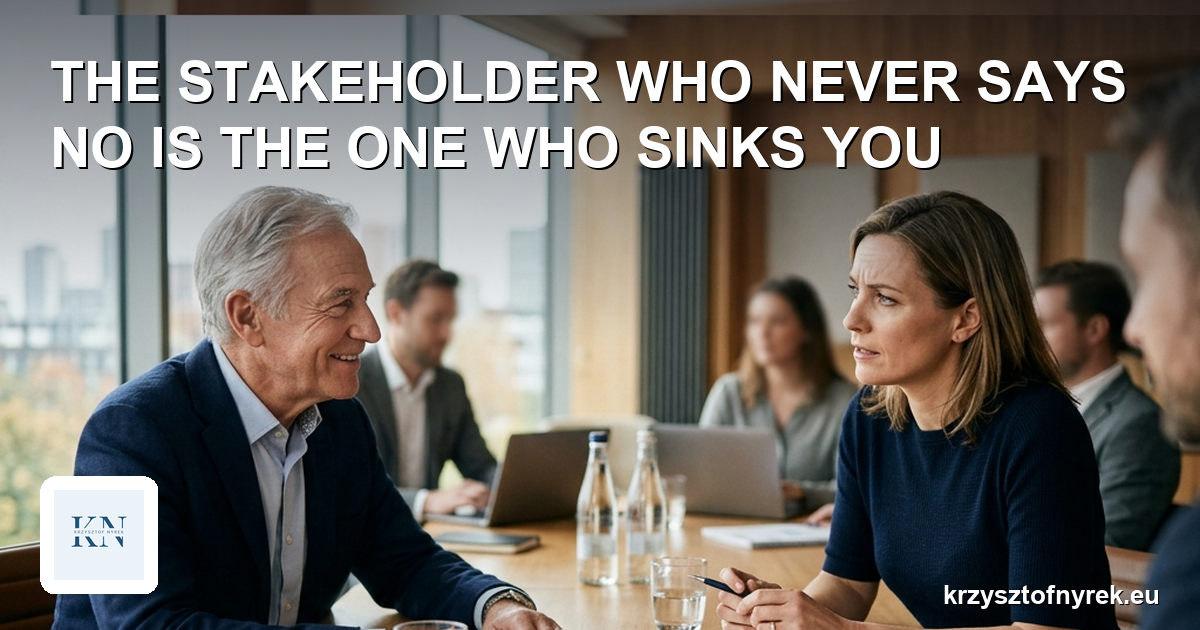

“Great idea, I’m all for it.” The operations director says it at every meeting. He agrees to the schedule, to the scope, to the change of scope and to moving the date. On the stakeholder map he sits in the top right corner: high influence, full support. The PM sleeps well.
In month four the project needs one thing from him. Two people from his department have to be assigned to testing. The director replies that of course he supports the project, but this quarter there are no people to spare. At the steering committee, when another director questions the point of the rollout, our ally stays silent.
Support that cost nothing for four months turned out, when tested, to be worth exactly that.
Why an open opponent is safer
A person who says “no” does the PM a favour. You know what they fear, you know where they will block, and you can talk to them about specifics. Their objection is in the plan.
A person who always says “yes” leaves no information behind. The PM doesn’t know what really matters to them, what they won’t agree to, or at which point they will disappear. Their agreement looks like an asset and is in fact an unknown.
The most dangerous part is that the project plan rests on such agreements. Every “I’m for it” gets written down as a commitment, although nobody checked whether there is anything more behind the word. It is one of the quiet ways the PMO and the board end up solving different problems.
Three kinds of easy agreement
In my experience an easy “yes” usually has one of three things behind it.
Agreement out of politeness. Someone doesn’t want to spoil the mood or has no time to get into the subject. They say “yes” so the meeting can end.
Agreement without understanding. Someone doesn’t know what the project means for their people and their budget. They agree to the general idea, and the objection will come when the idea turns into a specific request.
Agreement for show. Someone supports the project as long as a person more senior than them is watching. When the balance of power shifts, the support goes with it.
In none of these cases is the stakeholder lying. They really are “for it”, only the word means less to them than the PM wrote down.
How to check what someone’s “yes” weighs
There is one way to measure support: ask for something that costs. It is worth doing early and on a small scale, before the project starts depending on the answer.
Ask for one specific thing with a date. An hour of someone from their team next week. A signature on one document by Friday. The reaction to a small request says more than declarations at ten meetings.
Ask what would have to happen for them to say “no”. The question sounds odd, but it works. A person who answers specifically has thought their support through. A person who says “I can’t see that happening” hasn’t considered it yet.
Ask them to say the same thing in front of others. One sentence of support at the steering committee, or in an email to their own team. Support voiced in public is harder to withdraw quietly.
If none of these three requests goes through, the PM has just learned something important, and in month two rather than month four.
What to do with this on the stakeholder map
The classic map has two axes: influence and attitude. A third piece of information is useful, added next to each name: what this person has already done for the project.
For an opponent the entry may be short. For an enthusiastic supporter it is often empty, and that empty field is the signal. A stakeholder with high influence, full support and zero requests delivered belongs on the risk list, not on the list of allies. Judging them by what they did rather than by how the meeting felt is the same discipline as telling a good decision from a good outcome.
One question for this week
Who in your project always agrees? When did you last ask that person for something that cost them?
All situations described in this article are based on real events, but contain no company names, no individual names, and no data from any specific project.