Hi, I’m William Lina
a
Eye Sergeon Specialist
Eye Consultant
Explore the professional journey, expertise, and achievements of a dedicated medical practitioner. Discover education, experience, clinical skills, research, and patient care .
Special Facilities For Our Patients
Rehabilitation Retreat
A serene haven dedicated to physical and emotional recovery, providing specialized therapies.
Adventure Basecamp
An adventure facility providing equipment, training, and guided experiences.
Child Development
A nurturing environment for children's growth and learning, equipped with a range of developmental programs.
Dr. Laura Jerry
Dr. Laura Jerry brings a wealth of experience and expertise to her practice. With a focus on patient-centered care, she is known for her warm and empathetic approach, always taking the time to listen to her patients’ concerns. Her extensive medical knowledge and dedication to staying at the forefront of the field make her a trusted healthcare partner.
Explore the range of medical services Dr. Collins offers, including general check-ups, preventative care, chronic disease management, and more. She is committed to working with you to develop personalized treatment plans that suit your unique needs.
Services For You &
Your Family
Pediatric Healthcare
Your first line of defense in health. Our primary care services cover check-ups and vaccinations.
Specialist Care
Access to top medical specialists for in-depth evaluation and treatment of specific health conditions.
Women's Health
Tailored healthcare services for women, including gynecology, obstetrics, and reproductive health.
Geriatric Care
Specialized care for our senior patients, focusing on age-related health issues chronic disease.
Diagnostic Testing
State-of-the-art diagnostic services, including imaging, laboratory tests, and screenings
Testimonial
Nevine Acotanza
Chief Operating OfficerChief Operating Officer
Mar 4, 2015 - Aug 30, 2021 testMr. Lee displayed remarkable responsiveness, professionalism, expertise, and proficiency. He swiftly grasped the intended concept and guided me in creating an elegant and captivating presentation.
Jone Duone Joe
Operating OfficerOperating Officer
Mar 4, 2016 - Aug 30, 2021Sarah exhibited remarkable responsiveness, professionalism, knowledge, and expertise. She quickly understood the intended concept and guided me in creating a sleek and aesthetically pleasing presentation.
Nevine Dhawan
CEO Of OfficerCEO Of Officer
Mar 4, 2016 - Aug 30, 2021Maecenas finibus nec sem ut imperdiet. Ut tincidunt est ac dolor aliquam sodales. Phasellus sed mauris hendrerit, laoreet sem in, lobortis mauris hendrerit ante. Ut tincidunt est ac dolor aliquam sodales phasellus smauris
My Regular Scedule
Medical Diagnosis Treatment
- Address: Google Out Tech - (2017 - Present)
- Working Days: Monday, Wednesday, Saturday
- Visiting Hour: 9am - 4pm
- Contact No: +44 0015454500
Medical Diagnosis Treatment
- Address: Google Out Tech - (2017 - Present)
- Working Days: Monday, Wednesday, Saturday
- Visiting Hour: 9am - 4pm
- Contact No: +44 0015454500
Medical Diagnosis Treatment
- Address: Google Out Tech - (2017 - Present)
- Working Days: Monday, Wednesday, Saturday
- Visiting Hour: 9am - 4pm
- Contact No: +44 0015454500
Medical Diagnosis Treatment
- Address: Google Out Tech - (2017 - Present)
- Working Days: Monday, Wednesday, Saturday
- Visiting Hour: 9am - 4pm
- Contact No: +44 0015454500
Latest News
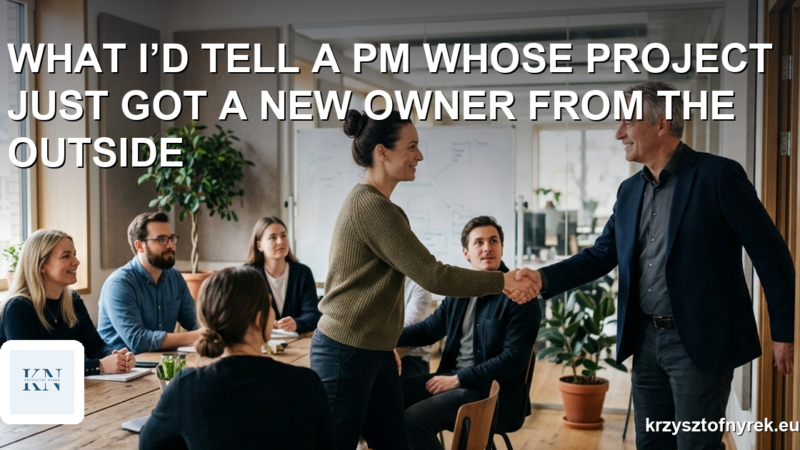
What I’d Tell a PM Whose Project Just Got a New Owner from the Outside
The director asks you in for a conversation and says that from Monday, for two weeks, there will be someone from outside in the project. They are there to “help sort it out”. You stay on as project manager, nothing changes.
You leave the room knowing that everything has changed. Someone has decided you can’t cope on your own. The team will find out tomorrow. The client probably already knows.
I have been that person from outside. Below is what I tell the project manager on day one, and a few things I usually don’t say and should.
This is not an assessment of you
I know that is how it looks. In most cases the decision to bring someone in is made for a different reason: the sponsor has a leadership review in two weeks and nothing to walk in with. They need a picture the room will believe. A picture from someone with no history of their own in the project is easier for them to defend.
Projects rarely get stuck because of one person. They usually get stuck on things the PM has no influence over: decisions that don’t get made, scope nobody defends, and people split between three subjects. Often the PM has been saying so for months and nobody listened.
What that person really needs
For the first few days someone from outside knows less about the project than anyone on the team. The only person who can change that quickly is you.
They need three things from you. A list of what has been promised, and to whom. A list of the decisions you are waiting for, with the date since which you have been waiting. Your own answer to the question of what you would change if you had the mandate to do it.
The third is the most valuable. Nine times out of ten the project manager knows what is wrong. They just had nobody to say it to in a way that would be heard.
What you can get out of it
The person from outside has something you don’t: for two weeks the sponsor listens to them. That ends when they leave, so it is worth using.
If you have been asking for a decision on scope for a quarter, say so on day one. If you are missing a person who was promised at the start, say that too. These things will go into the report as the findings of someone independent and will suddenly become urgent. The report itself will most likely follow the structure a sponsor update needs, so it helps to hand over your points in that shape.
Outside help done well ends with the PM holding more than they held before: a closed scope, decisions made, clear rules with the client.
What not to do
Don’t prepare a defence. A presentation showing that everything was done correctly takes two days and changes nothing, because nobody is asking about blame.
Don’t hide what is uncomfortable. The person from outside will find it anyway, usually on day three, in a conversation with someone from the team. Better that they hear it from you, along with the context.
Don’t disappear. Some project managers step back for those two weeks so as “not to get in the way”. Then the findings are made without them and are hard to put into practice afterwards.
What to ask on day one
You have a right to know the terms on which this is happening. Ask three things outright.
Who runs the project after the two weeks? If the answer isn’t “you”, it is better to know straight away.
Who tells the team and the client why this person has come? Ideally you say it together, in one sentence.
Will you see the findings before they go to the sponsor? Help that is run honestly shows them to the project manager first. If you hear “no”, that tells you how this cooperation is going to look.
What is left after two weeks
The person from outside leaves. The project stays with you, together with the decisions that have finally been made and a plan that now has to be carried out.
If those two weeks went well, you are in a better place than before them. If they went badly, it is usually because both sides spent the first week checking whether they could trust each other instead of working.
One question for this week
If tomorrow someone independent asked you what you would change in your project with a full mandate, what would you answer? Who can you say that to today?
All situations described in this article are based on real events, but contain no company names, no individual names, and no data from any specific project.
Closing a Project That Refuses to Close
The system has been live for three months. Users are working in it, half the team is already on something else, and in the status report the project is still “in progress”. There are eleven items left on the list. Two weeks ago there were nine.
Nobody can say when it will end, because everyone understands the end differently. For the team the project ended on go-live day. For the client it will end when the last remark disappears. For the sponsor, when they stop paying for it.
The last five percent of a project can take longer than the first ninety-five. That rarely comes from the difficulty of the work that is left. More often it comes from nobody having agreed what “finished” means.
Why the tail drags on
There are four reasons, and they usually come together.
A list that grows. Every closed remark gives birth to two new ones. The client looks at the system more closely than during testing and reports things they didn’t see before. Some of them are bugs, and some are new wishes written down as bugs.
A team that is no longer there. The best people have been moved to the next project. The fixes are done by someone who comes back to the subject for two hours a week and each time has to remind themselves how it works.
A signature nobody wants to give. For the client the acceptance report means the end of being able to raise remarks. As long as they haven’t signed, they have the supplier at hand. Delaying is reasonable for them. It is the last and most expensive form of the gap between the client’s “done” and the team’s “done”.
A sponsor who isn’t hurting. A project that works stops being urgent. The sponsor has new matters to deal with, and the tail of the old project doesn’t hurt anyone enough to be dealt with.
Close the list before you start shortening it
In my experience one move unblocks the tail: the list stops accepting new items.
It takes a conversation with the client and one date. Until that day we collect everything that needs fixing. After that day the list is closed, and every new thing goes on a separate list, to be handled by operations or by the next phase.
The client usually agrees if they get something in return: the certainty that the closed list will be done in full and by a set date. Until now they had neither.
While you are at it, go through the list once more and put each item into one of three groups: a bug that blocks work, a bug people can live with, and a new wish. Only the first group has to be done before closing.
Define “the end” on one page
A project that is to close needs a definition of closure written out plainly. Four sentences are enough.
What has to work. What is handed over to operations, and to whom. What was deliberately not done, and why. Who signs, and when.
The third sentence is the most important and the one most often left out. A list of things not done, written down and accepted, closes a project more effectively than an attempt to do everything. A project without such a list always has something left to finish.
Give the tail an owner and a date
The last stretch needs the same thing the whole project needed: one person responsible for it, and a deadline.
A short, separate closing phase works well. Two or three weeks, specific people assigned to it full time for that period, a daily review of the list. That costs less than three months of fixes done an hour a week.
It is worth showing the sponsor this calculation in time, not in money: the team has been going back to the old project for a quarter, and the new project is standing still because of it.
Closing is an event too
A project that ends quietly leaves people feeling that nothing ended. One short meeting makes a difference: what we delivered, what we are handing over, what we didn’t do and who we thank.
After that meeting the project disappears from the status report. It is a small thing, but only then does the team really move on to the next piece of work.
One question for this week
Do you have a project that works and is formally still running? What would have to be written on one page for it to be closed this month?
All situations described in this article are based on real events, but contain no company names, no individual names, and no data from any specific project.
The Weekly Report Everyone Skims and Nobody Challenges
In the first week of the project everyone reads the report. The sponsor replies with two questions, a director calls about one risk, someone asks for a date to be clarified.
In week three the sponsor replies “thanks”. In week six nobody replies. In week ten the report has the same structure, the same headings and half the same sentences as the week before, and the only person who reads it in full is the author.
Nobody decided to stop reading. The report simply stopped surprising anyone, and people quickly learn to skip what looks familiar.
What happens to a report nobody reads
The author is the first to notice. Since nobody asks, writing it takes less and less time. Sentences pass from week to week with a small change of date. “Work on the integration is ongoing” appears in the report for the fifth time running, and nobody has asked why it is taking so long.
There is no ill will in this. A report written for nobody turns into a ritual. Bad news put into such a report can sit there for three weeks, and formally everyone has been informed. This is how status reports stay “on track” for weeks right before a project turns red.
That is how a good tool becomes an alibi. The author can say they wrote it. The reader can say they received it.
Five minutes that give the report its meaning back
In my experience a report starts working again when at least one person reads it with three questions in mind. It takes five minutes.
What has changed since last week? I put the last two reports side by side. If they differ only in the date, then either nothing happened in the project or the report has stopped describing the project. Both cases are worth one question.
Which sentence is here for the third time? “In progress”, “work is ongoing”, “waiting for a reply”. Each of them is fine for a week. After three weeks it means something is stuck and nobody has called it that.
What isn’t here that used to be? A risk that vanished from the list without a word of explanation. A task there was a lot about three weeks ago and nothing today. Things rarely disappear from a report because they were solved. More often they disappear because they became uncomfortable.
One question in reply
After those five minutes it is enough to reply with one question. Not a list of remarks and not an assessment, just one specific question about one sentence in the report.
“The integration has been in progress for three weeks. What is holding it?”
The effect is bigger than one sentence would suggest. The author learns that someone is reading and writes the next report more carefully. After two or three such questions, sentences copied without thought disappear from the report, because any of them may come back with a question.
Tone matters. The question should sound like curiosity, not like catching someone out. An author who gets an interrogation in return for honesty will start writing more cautiously, which means less truthfully.
If you are the one writing the report
The same mechanism works the other way round. A PM who sees that nobody reads their reports can check that and change it.
The simplest way is to end the report with one question to the reader that needs an answer. If nobody answers for two weeks, the report isn’t getting through, and it is better to know that now than on the day there is something important in it.
The second way is to cut it in half. A one-page report in which most sentences change every week gets read. A four-page report in which one sentence changes does not. The four-part structure a sponsor update needs fits on that one page.
One question for this week
Take the last two reports from a project you oversee or run. Which sentence is identical in both, and what is really behind it?
All situations described in this article are based on real events, but contain no company names, no individual names, and no data from any specific project.