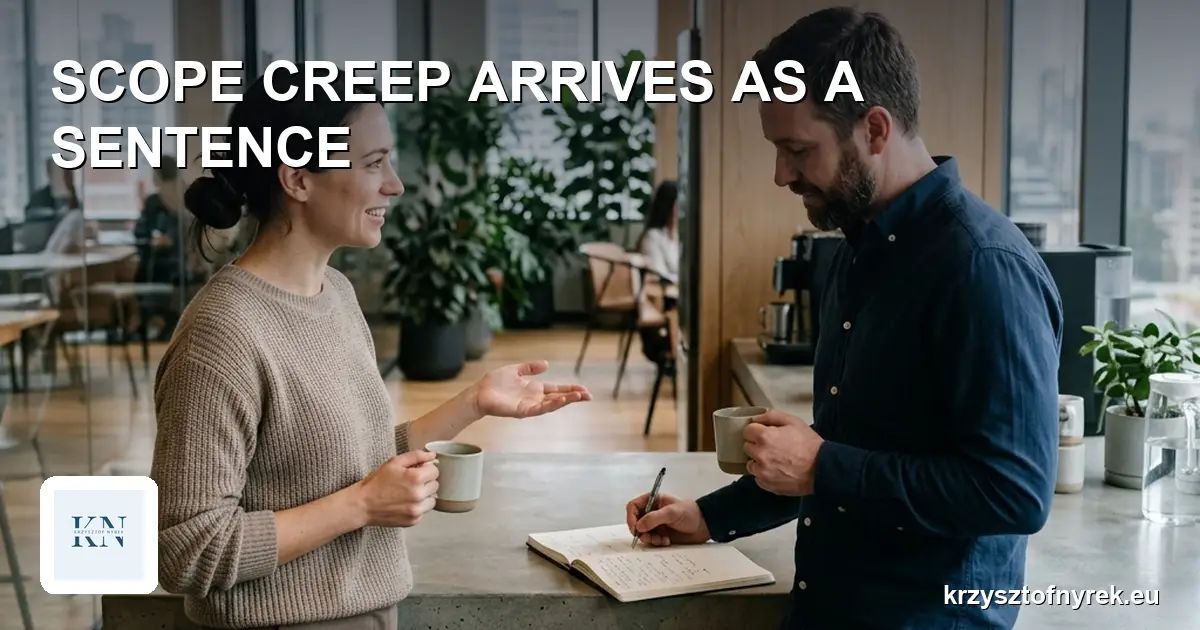

No project I’ve ever run grew because of a decision. Nobody ever called a meeting and said: “we’re expanding scope by three weeks of work, do you accept?” If it had happened that way, we’d probably have said no, or at least priced it, and had the conversation about scope versus value that a change like that deserves.
Scope grows differently. It grows through sentences dropped in passing, sentences that sound so harmless that nobody stops the conversation to take a closer look.
Sentences I know by heart
After all these years I have a whole collection. A few of them come up in every industry.
“Since you’re already in there, maybe you could also…”
“That’s just a small thing, right?”
“I thought it was obvious that this would be included.”
“The client only asked whether it would be possible to…”
“Just do it this way for now, we’ll sort it out later.”
None of them is a problem on its own. The problem is that at the moment it’s said, nobody treats it as a scope change. We treat it as a question or a request for a favor, and favors don’t get priced.
Why we don’t catch it the moment it’s said
The first reason is simple: we don’t want to look like the people who count every minute. The relationship with the client, or with the business side, matters, and a reply like “that’s a scope change, I need to price it” lands like a cold shower in the middle of a pleasant conversation.
The second reason is less obvious. Often, when the sentence is said, we genuinely don’t know what it costs. “One extra report” can be an hour of work or a week, depending on where the data has to come from. So we say “we’ll see” and go back to the agenda. And to the other side, “we’ll see” sounds like “yes.”
I remember a project where eleven of these “small things” piled up over two months. Each one was reasonable on its own. Together they pushed the deadline back by three weeks, and at the wrap-up meeting nobody could point to the moment when we decided on that delay, because there was no such moment.
One sentence in reply
You don’t need a fifteen-page change management procedure to catch this. You need one sentence, said in the same conversation, at the same moment.
I use something like this: “Fine, I’m writing that down. I’ll check what it costs and what it pushes back, and get back to you by tomorrow, before we start.”
That sentence does three things at once. It doesn’t refuse, so it doesn’t damage the relationship. It names the request as something with a cost, which changes its status from a favor to a change, and it sets a deadline, so the other side knows the topic won’t vanish.
The most important part is “before we start.” Without it, the team hears the request and starts working, because it’s just a small thing, and you come back with a price for something that’s already half done.
What to do with the estimate
When you come back, you don’t bring just a number. You bring a choice. “The extra report is four days. We can do it now and move the deadline by those four days, we can do it in the second phase, or we can swap it for something we haven’t started yet.”
Most of the time the answer is “second phase.” Not because the other side got scared, but because for the first time they saw what the request costs. Over coffee, it looked free.
Sometimes the answer is “do it now, move the deadline.” That’s a good outcome too. Scope grew, but it grew through a decision, not a sentence, and three months from now everyone will know where the delay came from.
Holding the line doesn’t take authority
Plenty of PMs tell me they don’t have the authority to defend scope, because the client matters more and the boss will agree anyway. I understand that, I’ve been on projects like that myself.
But that sentence doesn’t require authority. You’re not saying “no.” You’re saying “it costs something, I’ll check how much.” You don’t need anyone’s permission for that. You only need the habit of saying it in the same minute the request is made, not a week later, when everyone already considers it part of the project.
All situations described in this article are based on real events, but contain no company names, no individual names, and no data from any specific project.